WarehousePG Enterprise Manager architecture
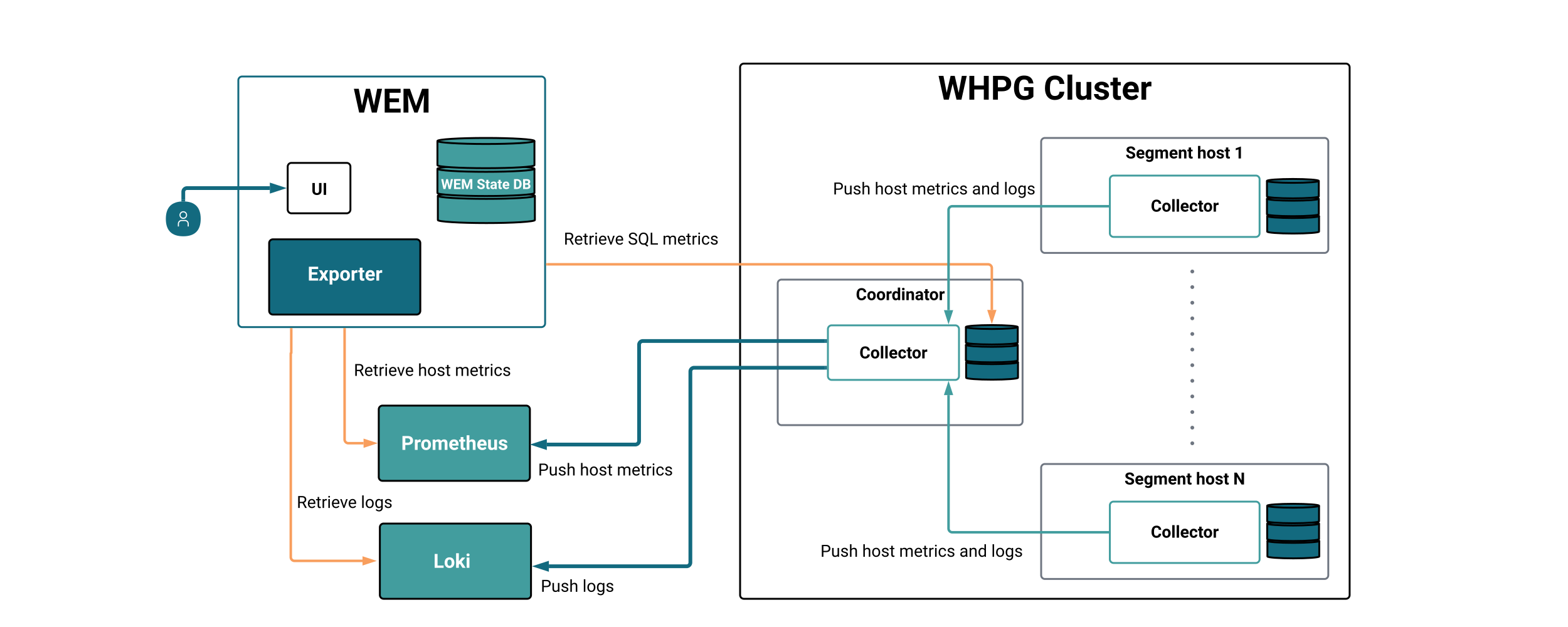
The WarehousePG Enterprise Manager (WEM) architecture is built upon a streamlined telemetry pipeline: an internal data collection layer (Collector), dedicated storage services (Prometheus and Loki), and the unified WEM application which now includes a built-in Exporter engine.
Components
Collector
The Collector is a service based on Grafana Alloy that runs on the WarehousePG (WHPG) coordinator, standby, and segments. Each Collector service on the WHPG cluster collects host metrics and log files, and sends them to the Collector service on the coordinator. The Collector service on the coordinator temporarily stores these metrics in memory, then pushes the host metrics to Prometheus, and the log files to Loki.
WEM
WEM is the central management and visualization service. It includes the Exporter as a native service, eliminating the need for a separate installation.
WEM performs the following core functions:
- Database extraction: The integrated Exporter engine runs SQL queries against heap and catalog tables to capture deep database metrics.
- Data routing: Pushes captured SQL and cluster metrics to Prometheus for historical analysis.
- Unified visualization: Aggregates live data directly from the internal Exporter engine and historical data from Prometheus and Loki into a single dashboard.
Storage services: Prometheus and Loki
WEM leverages industry-standard storage engines to handle high-velocity telemetry. You can deploy dedicated instances for WEM or integrate with your existing enterprise monitoring stack:
- Prometheus: The time-series database for all numerical data. It receives host metrics from the Collector and SQL/Cluster metrics from the internal WEM Exporter.
- Loki: The log aggregation engine. It receives high-volume log streams directly from the Collector on the coordinator.
Note
While WEM can function as a standalone tool without Prometheus and Loki, its capabilities will be limited to real-time cluster status and SQL execution data; historical trends, host-level metrics, and log aggregation require the external storage services.
WEM operational workflow
The system processes telemetry across four distinct phases:
Collection: Collector agents on every node harvest raw OS metrics and log entries, and the data is tunneled to the coordinator node.
Export & routing:
- System & logs: The Collector on the coordinator pushes system metrics to Prometheus and logs to Loki.
- Database metrics: The internal WEM Exporter engine probes the WHPG engine to capture the state of queries, transactions, and resource usage.
Storage: Data is indexed and stored externally within Prometheus and Loki. This ensures that even if the database cluster faces downtime, its historical metrics and logs remain available for root-cause analysis.
Visualization: WEM assembles the operational picture by pulling from three sources:
- Prometheus: For hardware performance and historical SQL trends.
- Loki: For searchable log files across the cluster.
- Exporter: For the real-time view of active sessions and current cluster status.
Could this page be better? Report a problem or suggest an addition!